
Roofing blog
Black Streaks and Moss on Michigan Roofs: What They Are and What to Do
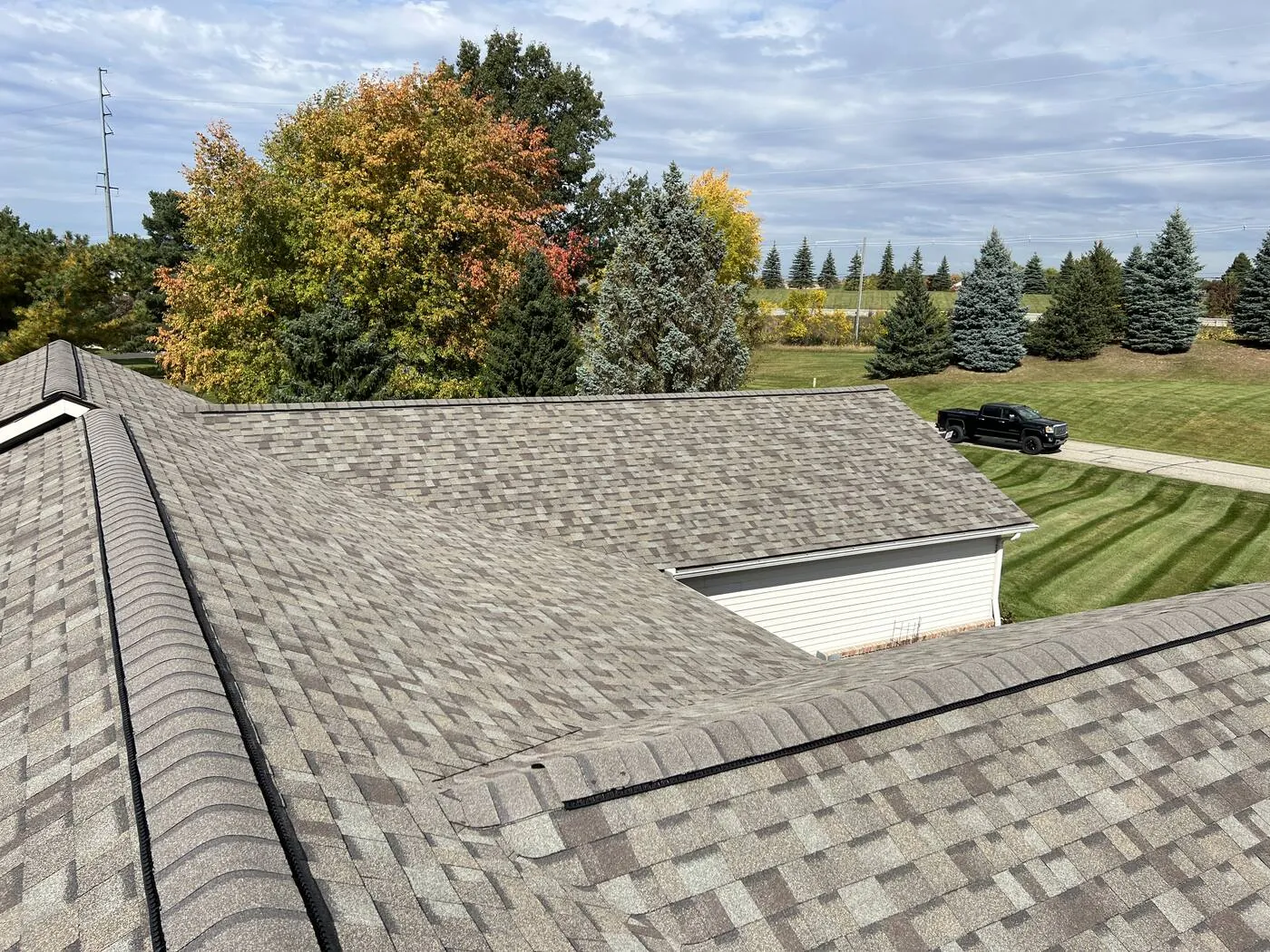
Stand at the end of almost any driveway in Howell, Pinckney or Hamburg in late summer and look at the north slope of the roof. On a lot of houses you will see dark vertical streaks running down from the ridge, and on the wettest, shadiest roofs, green cushions of moss sitting in the shingle courses. Homeowners call us about this constantly, usually asking the same two questions: is my roof rotting, and can it be cleaned. The answers are reassuring on one count and less so on the other, and they are not the same answer for streaks and for moss.
The black streaks are algae, not dirt and not mold
What you are looking at is a blue-green algae called Gloeocapsa magma. The Asphalt Roofing Manufacturers Association identifies it as the organism behind nearly all dark roof discoloration. It travels through the air as spores, lands on a roof, and feeds on moisture and on the limestone filler that manufacturers blend into asphalt shingles. As the colony grows it builds a dark protective sheath against ultraviolet light, and that sheath is the black you see. The streaks run vertically because rain carries the colony down the slope.
It shows up on north-facing slopes first because those slopes get the least direct sun and stay damp the longest after a rain or an overnight dew. Add the tree cover that most of Livingston County enjoys — the wooded lots west of Howell, the older neighborhoods around Thompson Lake, most of Pinckney and Hamburg — and you have shade, humidity and leaf litter working together. Michigan summers are humid enough that this is not an unusual roof problem here. It is the normal condition of an older roof on a shaded lot.
What algae does and does not do to your roof
Here is the reassuring part. Algae itself is a cosmetic problem. It does not eat through the shingle mat, it does not cause leaks, and a streaked roof is not automatically a failing roof. We inspect plenty of heavily streaked roofs with a decade of service life left in them.
The part that matters is indirect. A dark colony absorbs more heat than the granule surface around it, which means the streaked areas of the roof run warmer and age slightly faster than the clean areas. It also holds moisture against the shingle for longer after every rain. Neither effect will destroy a roof on its own, but on a shingle already twenty years into a Michigan freeze-thaw cycle, it is one more thing working against you.
Moss is a different problem, and it is the one to take seriously
Moss is a plant, not an algae, and it has structure. It grows thick, it grows upward, and critically, it grows into the gaps at the bottom edge of each shingle course. As it swells with water it lifts the shingle edge, which breaks the seal the shingle depends on and opens a path for wind-driven rain to get underneath. Moss also holds standing water against the shingle indefinitely, and in a Michigan winter that water freezes, expands, and works granules loose. A shingle that has lost its granules has lost its UV protection, and it will fail early.
If you can see green cushions in the shingle courses rather than flat black streaking, the roof needs attention now, not next year. This is especially common on the shaded, low-slope sections over porches and additions, and on roofs with mature maples or oaks hanging directly overhead.
Can it be cleaned? Yes — and mostly wrong
Algae can be removed, and the method matters more than most homeowners realize. ARMA's guidance is specific: apply a solution of liquid household bleach (sodium hypochlorite) and water, let it sit on the surface for at least fifteen minutes but no more than twenty, then rinse gently with water. That is it. No scrubbing, no agitation.
ARMA is equally specific about what not to do, in capital letters: do not use a power washer, and do not use any kind of brush or broom. High pressure on an asphalt shingle strips granules by the handful and drives water up under the courses. A brush does the same thing more slowly. The most common way we see a roof genuinely damaged by algae is not the algae — it is a pressure washer aimed at it. Pressure washing also voids most shingle manufacturers' warranty coverage, so a homeowner trying to save a roof can end up with a shorter-lived roof and no warranty behind it.
There is also the safety question, which is not a small one. A wet, bleach-slicked Michigan roof is genuinely dangerous footing, and the slopes on most two-story homes in Brighton and Hartland are steep enough that this is not a ladder-and-a-Saturday project. If the roof is going to be cleaned, it should be cleaned from a ladder at the edge with a low-pressure applicator, or by someone who does this work with proper fall protection.
How to keep it from coming back
- Cut back the branches. Anything overhanging the roof keeps it shaded and drops organic debris that algae and moss feed on. Trimming back to give the slope morning sun does more than any cleaning product.
- Keep the gutters clear. A gutter full of needles and leaves backs water up onto the lowest shingle course, which is exactly where moss takes hold first.
- Clear the valleys and the low-slope sections. Debris sitting in a valley holds water for days after a rain.
- Install zinc or copper at the ridge if streaking is chronic. Rain washing over the metal carries trace amounts of the metal down the slope, and algae will not colonize where it settles. It is slow, partial and mostly preventive rather than a cure, and it works best installed at the same time as new shingles.
- When the roof is replaced, specify algae-resistant shingles. ARMA notes that several types of algae-resistant shingles are commercially available, and they work by blending copper into the granules. On the Owens Corning products we install this is marketed as StreakGuard, and it carries its own algae warranty period. On a shaded Livingston County lot, this is not an upgrade to think about — it is the correct specification.
When streaking means it is time for a new roof
Algae is a symptom, not a verdict. But the roofs we find it on are usually older roofs, and the question worth asking is not "can I clean this" but "what is the rest of this roof telling me." Look for granules collecting in the gutters and bare dark patches where the granule layer has worn thin. Look at whether the shingles still lie flat or have started to curl at the edges. Lift a tab at the rake and see whether the sealant strip underneath still grabs. Check whether the streaking is joined by moss in the courses, cracked pipe boots, or rusted flashing at the chimney.
A roof that is streaked and otherwise sound is a candidate for cleaning and trimming. A roof that is streaked, mossy, losing granules and past twenty years old is a roof to plan a replacement around — and cleaning it is effort and risk spent on a surface that is coming off anyway. If moss has already lifted shingle edges and water has been getting underneath, the honest conversation is about roof repair on the affected slope or replacement of the whole roof, depending on what the deck underneath looks like.
Have someone look at it before you climb up there
We inspect roofs across Livingston County at no charge, and we will tell you plainly which of the three situations you are in: cosmetic streaking on a roof with years left, moss that needs handling now, or a roof at the end of its service life where cleaning is not the right move. You get the answer in writing either way, including photographs of what we found on the slopes you cannot see from the ground. Call (810) 588-3933 or use the form on this site.