
Roofing blog
Can You Shingle Over an Old Roof in Michigan?
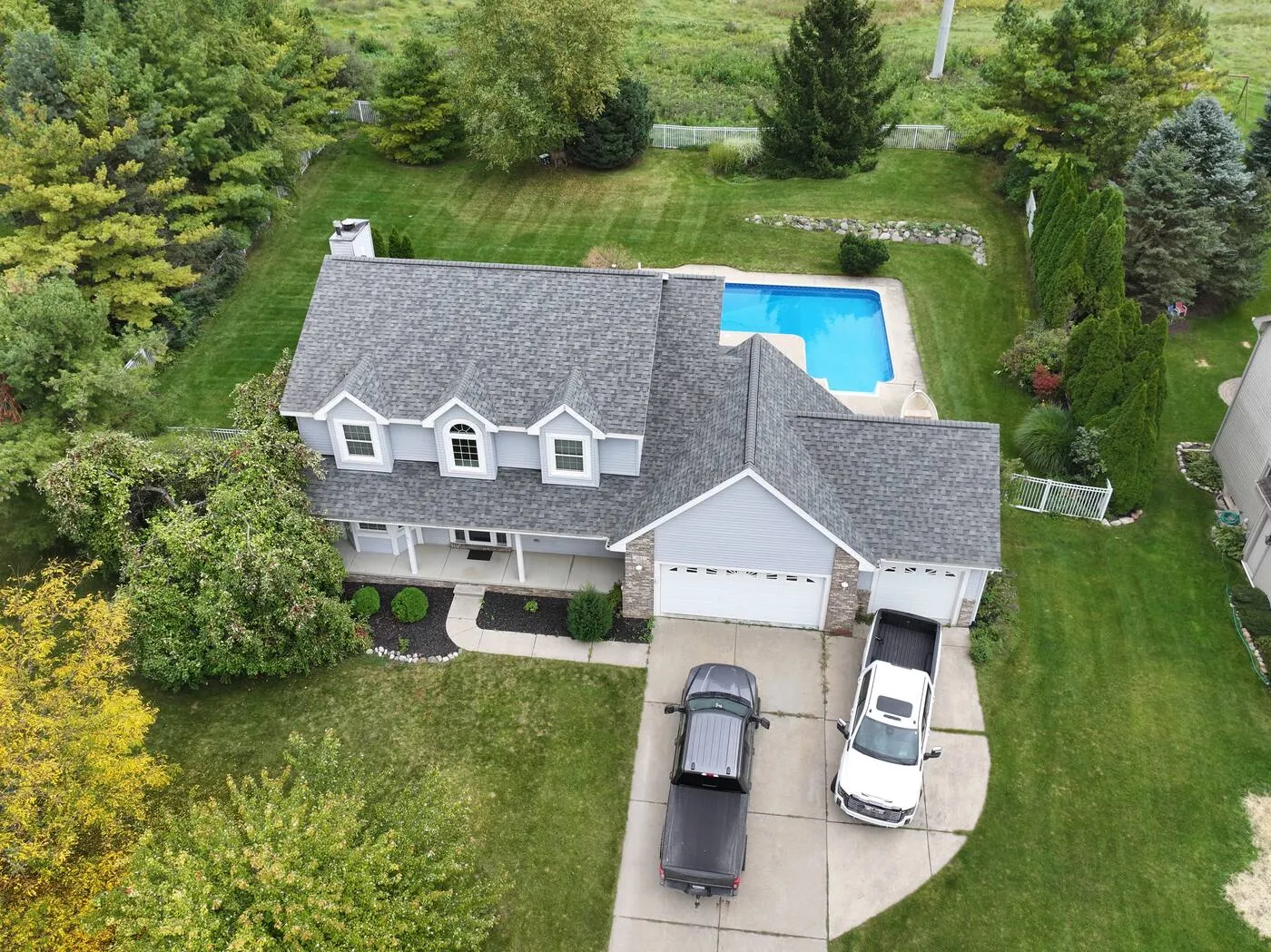
Sometimes, legally. Rarely, wisely. Putting a new layer of shingles directly over the old ones — a layover, a roof-over, a recover — is a real method with a real place in the trade, and it is also the shortcut most likely to leave a Michigan homeowner with a roof that fails early and cannot be diagnosed. Here is what the code allows, what it forbids, and what we tell homeowners in Howell, Brighton and Hartland who ask.
What Michigan code actually says
The Michigan Residential Code addresses this directly in its chapter on roof assemblies. Section R908.3 requires removal of existing layers where the existing roof has two or more applications of any type of roof covering. In plain terms: one existing layer may be recovered over; two existing layers must come off. There is no third layer.
The code also prohibits recovering in several other situations regardless of layer count — where the existing roof or its decking is water-soaked or deteriorated to the point that it is no longer adequate as a base, and where the existing covering is the sort that will not provide a sound substrate. Slate, clay tile, wood shake and asbestos-cement shingles cannot be recovered over.
Permitting in Livingston County adds a practical wrinkle worth knowing. The City of Howell requires a permit for any re-roof, whether it is a layover or a tear-off. The Livingston County Building Department, which handles Howell, Oceola, Marion and Genoa Townships, applies what amounts to a tear-off test: stripping the old covering requires a permit, while a layover over a single existing layer does not. Because a Howell mailing address does not tell you which jurisdiction you are in — the four surrounding townships mail as Howell but permit through the county — the answer to "do I need a permit" genuinely depends on which side of a township line the house sits on. Any contractor working in this county should know which office your address answers to, and requirements change, so confirm current rules with the building department that covers your property.
Why layovers are attractive
They are faster. A layover skips the tear-off, the disposal and the day of noise and debris in the driveway. There is no window where the house is open to weather, which on an unpredictable Michigan week is not nothing. On a simple gable roof with one sound layer of flat, undamaged three-tab shingles and clean decking underneath, a layover installed carefully is a legitimate roof.
That last sentence has four conditions in it, and in fifteen-plus years of roofs in this county, all four are true less often than homeowners expect.
Why we almost always recommend a tear-off instead
You cannot inspect a deck you never uncover
This is the whole argument in one line. The most common serious problem we find on Michigan roofs is soft, delaminated sheathing in the lowest few feet above the eave, caused by years of ice damming pushing water back under the shingle courses. It is invisible from above with shingles on. A layover covers it, and the new shingles are then nailed into decking that will not hold a fastener at the value the shingle's wind rating depends on. Two or three winters later there is a leak, and now the diagnosis requires removing a roof that is nearly new.
There is no ice barrier in a layover
Code section R905.1.2 requires an ice barrier extending from the lowest edges of all roof surfaces to at least 24 inches inside the exterior wall line. That membrane bonds to the deck. It cannot be installed over old shingles in any meaningful way, which means a layover on a home in a climate that crosses the freezing line roughly a hundred days a year leaves out the single layer specifically designed for our failure mode. On a house that has already had ice dams, a layover is the wrong answer regardless of what the layer count allows.
The new roof inherits the old roof's shape
Shingles telegraph. Every curled edge, cupped tab, swollen deck seam and high nail underneath shows through the new layer, and the new shingles cannot lie flat over them. A shingle that does not lie flat does not seal properly, and a shingle that does not seal is the one the next 60 mph gust takes off. Architectural shingles are heavier and more forgiving than three-tab, but they are not a leveling compound.
Flashing usually gets reused, and it should not be
A tear-off is when new step flashing gets woven into the courses at walls and chimneys, new valley metal goes in, and the pipe boots that split from ultraviolet exposure around year twelve get replaced. Layovers tend to caulk over the old flashing and move on. Reused flashing is the most common source of a leak on a roof that is otherwise brand new.
Weight, heat and warranty
Two layers of asphalt shingles is real added dead load on the framing, and it matters most on older plank-decked homes — which in the City of Howell, where better than fifteen percent of the housing stock predates 1940, is a lot of homes. Two layers also hold more heat, and a hotter shingle ages faster. And manufacturers' system warranties, including the Owens Corning system warranty we register for our customers, are written around a complete installed system over a sound deck. A layover generally cannot be registered for that coverage, which means the homeowner trades away the longest-term protection available for the fastest installation available.
The buyer and lender problem, three years later
One more consequence worth knowing before you choose. HUD's guidance for FHA appraisals accepts a maximum of three layers of existing roofing and requires that where more than two layers exist and repair is necessary, all old roofing must be removed as part of the re-roofing. A layover today means the next roof on that house must be a tear-off, and it means a buyer's inspector will count the layers and note them. Insurers ask about layers too. A layover is not just a decision about this roof; it is a decision about the next transaction.
When a layover is genuinely the right call
- One existing layer, flat and undamaged, on decking with no history of leaks, staining or ice damming
- A simple roof with few penetrations, no valleys and no wall tie-ins
- An outbuilding, detached garage or pole barn where the assembly is simple and the stakes are lower
- A short, defined bridge — a homeowner who needs a few more seasons out of a structure for a specific reason and understands exactly what they are getting
What we do
We will tell you honestly whether your roof is a layover candidate, and on most Livingston County homes the answer is no. Residential roof replacement is what we specialize in, and we do it as a full tear-off: decking inspected and replaced where it is bad, ice and water barrier past the code minimum at every eave and in every valley, all new flashing, balanced ventilation corrected, and the roof replacement registered as a complete Owens Corning system under your name — which we can do as an Owens Corning Platinum Preferred Contractor, a designation about one percent of roofing contractors hold. Where a targeted roof repair is the honest answer instead of any kind of new roof, we say that too.
If someone has offered you a layover and you want a second opinion on whether it makes sense for your house, the inspection is free and the answer comes in writing with photographs. Call (810) 588-3933.