Roofing blog
Choosing a Shingle Color for Your Michigan Home: Brick, Siding, Trees and Gray Skies
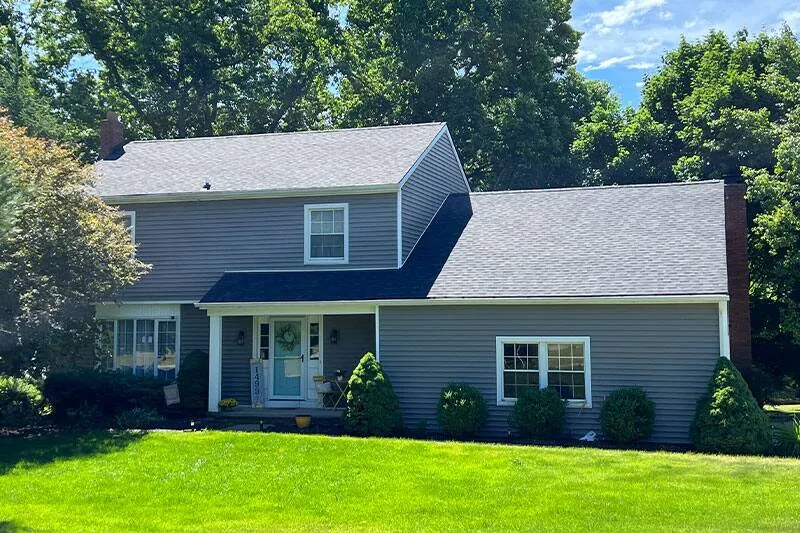
Shingle color is the decision homeowners agonize over and then have to live with for thirty years. It is also the one where a sample board in a showroom tells you almost nothing. Here is how we help Livingston County homeowners pick a color that looks right on their house, in their yard, under a Michigan sky.
Start with what is not changing
Your brick is not changing. Your stone is not changing. Your siding might, but probably not this year. The roof has to work with those. A few rules that hold up on almost every house we have done.
- Red or orange-toned brick, which is most of the brick in Howell and Brighton, looks best with a roof that has some brown or warm gray in it. A pure black roof on warm red brick can look harsh. A weathered wood or a driftwood blend usually looks right.
- Gray, white or painted brick, and gray or blue siding, want a cooler roof. Charcoal, slate, or an estate gray. The blue Cape Cod in our gallery is a good example: a cool dark gray roof that lets the siding do the talking.
- Tan, beige or cream siding, common on ranches from the 1970s and 1980s, works with browns and warm grays. We roofed a cream ranch home recently where a brown blend made the whole house look newer without changing anything else.
- Dark siding, deep greens, navy or the black-trim farmhouse look that is popular in new builds around Hartland and Genoa Township, almost always goes with a true black or charcoal roof.
Think about the trees
Livingston County is wooded. A house on a lot full of oaks and maples sits in shade and green for half the year and in bare branches and gray for the other half. Very dark roofs can disappear into a shaded lot. A mid-tone blend with some lighter granules keeps the roof visible and gives the house definition. On open lots in the newer subdivisions with young trees, a darker roof reads cleaner against the sky.
Our sky is gray a lot
Southeast Michigan gets long stretches of overcast from November through March. Colors look flatter and cooler under that light than they do in a sunlit showroom. A shingle with a multi-tone blend holds its character on gray days better than a flat single-color shingle. This is one reason we steer most homeowners toward architectural shingles with a real blend of granule colors rather than a solid tone.
Dark versus light and the attic
You will read online that light roofs keep a house cooler. That is true in Phoenix. In Michigan the attic temperature is controlled far more by ventilation than by shingle color. A dark roof with a proper ridge vent and open soffits runs cooler than a light roof with three box vents. Pick the color that looks right and let us handle the ventilation.
Look at it on a real house
The single most useful thing you can do is see the color on a full roof, in your area, at the time of day you usually look at your own house. We keep a list of homes we have roofed around Howell, Brighton, Hartland and Pinckney in each of the common colors, and we will send you addresses so you can drive by. A full roof of a color looks nothing like a twelve-inch sample.
The second most useful thing is to take the sample boards outside and lean them against your house at the roofline, then look from the street. Not in the garage. Not on the kitchen table.
HOAs and neighbors
If you are in a subdivision with an association, get the approved color list before you fall in love with anything. Even without an HOA, look at the roofs on either side of you. Matching them exactly is not necessary, but a bright roof on a street of charcoal ones will always look like the odd house out.
The colors we install most in Livingston County
Estate gray and onyx black lead in the newer subdivisions. Driftwood, desert tan and brownwood blends are the workhorses on brick colonials and older ranches. Teak and terra cotta show up on Tudor-style homes and on houses with a lot of warm stone. We can show you every one of these on a real roof.
One more thing
A roof looks best when the details match it. Drip edge, ridge cap and pipe boots should match the shingle. Gutters and downspouts should coordinate with the trim. We take care of that in the specification so you do not end up with a brown roof, white drip edge and black pipe boots. Request a free inspection and bring your questions about color. We will bring the boards.