
Roofing blog
Roofing a Lake Home in Livingston County: What Changes When Water Is 100 Feet Away
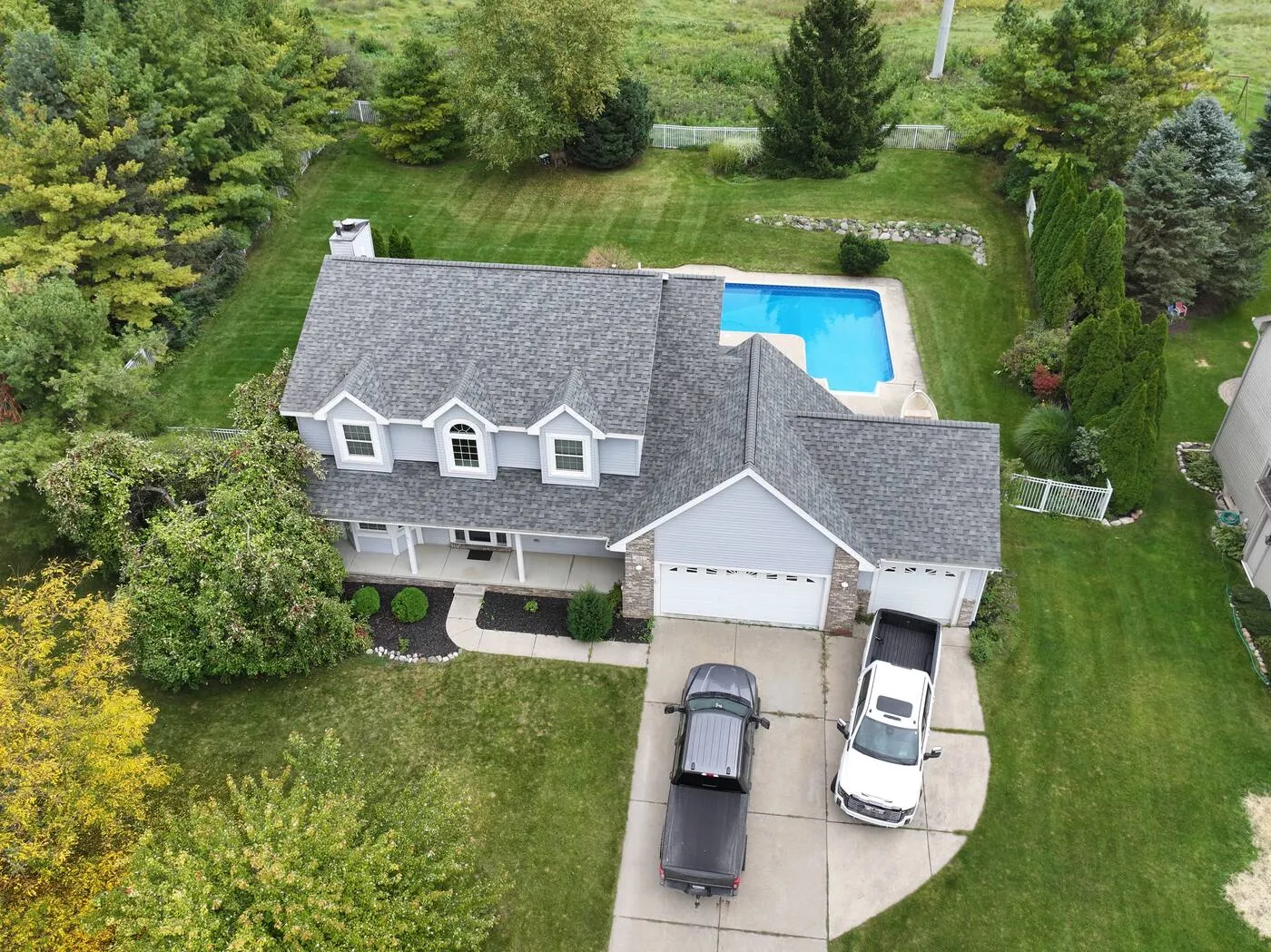
Livingston County has more inland lakes than most people outside Michigan would believe. Lake Chemung and Thompson Lake in Howell. Woodland Lake and Lake of the Pines in Brighton. Lake Shannon in Hartland and Tyrone Township. The Portage, Whitewood and Zukey chain down by Pinckney and Hamburg. If your home sits on one of them, your roof is living a harder life than the same roof two miles inland. Here is what we see on lake roofs and what we do differently when we replace them.
Wind has nothing to slow it down
Open water is a runway for wind. A gust that gets broken up by trees and houses in a Howell subdivision arrives at a lakefront home at full speed. The roof plane facing the water takes it head on, and the eave on that side is where we find the first lifted shingles almost every time.
What we do about it: on lake homes we treat the water-facing slope as a high-wind zone. That means six nails per shingle instead of four, a starter strip with a real adhesive band along the eave and the rakes, and hand-sealing the first course if the install happens in cool weather when the factory seal strip will not bond on its own. It is the same detail we would use on a house sitting on an open field north of Fowlerville. It is not optional near water.
Moisture, shade and moss
Lake lots tend to be wooded, and a north-facing roof slope under oaks and maples near water stays damp for days after a rain. That is the recipe for moss and algae. Moss lifts shingle edges and holds water against the roof deck. Algae streaks are mostly cosmetic but they tell you the roof is staying wet.
What we do about it: algae-resistant shingles with copper-infused granules are the default recommendation on shaded lake roofs. We also look hard at the trees. A branch hanging six feet over a roof drops leaves, shades the shingles and gives squirrels a bridge. Trimming it back is the single best thing a lake homeowner can do for their roof between replacements.
The seasonal-cottage problem
A lot of homes on Lake Chemung, Thompson Lake and the Pinckney chain started as summer cottages and were expanded room by room over decades. We open these roofs up and find three different framing methods, a flat section from a 1970s addition tucked behind a gable, and a valley that was never flashed properly because the two roofs were built ten years apart.
What we do about it: the inspection on a cottage-turned-house takes longer, and we tell you that going in. We photograph every transition, every dead valley and every low-slope section, and we spec the right material for each one. A shingle that works on a 6/12 gable is the wrong product on a 2/12 addition roof. Those get a proper low-slope membrane, and the transitions get ice and water barrier well past the code minimum.
Ice dams are worse on the water side
In winter the lake side of the house gets more wind, more drifting snow and more freeze-thaw cycles. Ice dams along the water-facing eave are common on older lake homes, especially where the cottage era left little or no attic ventilation.
What we do about it: ice and water barrier from the eave up past the exterior wall line by a wide margin, a continuous ridge vent paired with real intake at the soffit, and a frank conversation about attic insulation. We are roofers, not insulators, but a roof cannot fix an attic that is dumping heat into the snow.
Access and cleanup on a lake lot
Lake homes are often on narrow lots with the driveway on the road side and the good view on the water side. Getting a dumpster in, staging materials and keeping nails out of a lawn that runs down to a dock takes planning.
What we do about it: we walk the lot with you before the job and agree on where the dumpster and the material drop go. We tarp landscaping on both sides of the house, run magnets across the lawn and down to the shoreline, and we do it twice. Kids and dogs run barefoot on lake lawns. We know that.
Township rules near water
Genoa, Hamburg, Oceola, Hartland and Tyrone townships each have their own permitting process, and homes close to a lake sometimes sit in floodplain or setback zones that add a step. We pull the permit and handle the inspection scheduling. You should never be the one calling the township about your own roof.
If you own a lake home in Livingston County
Have the roof looked at every couple of years, not every ten. Look at the water-facing slope after every big wind event. Keep the trees off the roof. And when it is time to replace, work with a roofer who has done lake homes before and will tell you where the last roof went wrong. We have replaced roofs on most of the lakes in this county. Request a free inspection and we will show you what your roof is dealing with.