
Roofing blog
Skylights and a New Roof: Replace Them, Reflash Them, or Get Rid of Them?
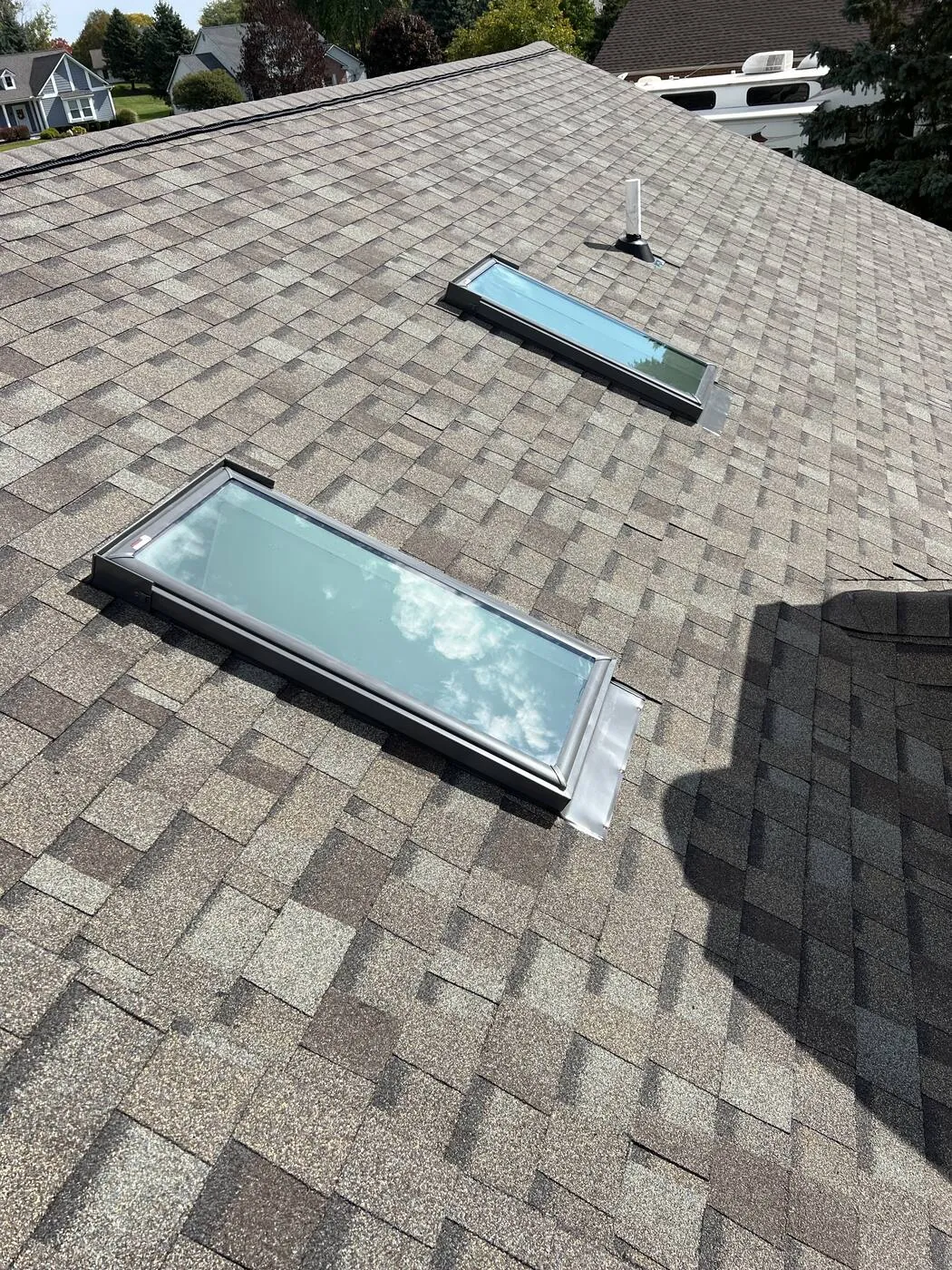
A lot of homes built in Livingston County from the late 1980s on have skylights. Kitchens, bathrooms, great rooms with vaulted ceilings. When it is time to replace the roof, the skylight question comes up on almost every job, and the answer the homeowner wants to hear is usually just leave them. Here is why we push back on that, and how we decide what to do with each one.
A skylight is a hole in your roof
That is not a criticism. It is how you should think about it. Every skylight is a place where water has to be directed around an opening, and the parts that do that directing are the flashing kit and the seal between the glass and the frame. Those parts age at the same rate as the roof. When the shingles around a skylight are twenty-five years old, so is the skylight.
The three choices
Replace the skylight
This is what we recommend on most roofs where the skylights are original. The manufacturer of a modern skylight designs it to be installed with the roof, using a flashing kit sized to that unit and that shingle type. The glass is better, the seals are better, and the whole assembly is warrantied together. If you replace the roof and keep a twenty-five-year-old skylight, the roof is warrantied and the skylight is not, and when the skylight leaks the water stains look exactly like a roof leak.
Reflash the existing skylight
If the skylight is newer, the glass is clear with no fogging between the panes, and the frame is sound, we can keep it. It comes out, the deck around it gets ice and water barrier, the skylight goes back in with a new flashing kit, and the shingles are woven around it correctly. This is a real option and we do it. It is not the option when the skylight is the original 1990s acrylic dome that has gone cloudy.
Remove it and close the roof
Some homeowners are done with the skylight. It is in a bathroom nobody uses, it drips condensation in January, or it is on the west slope and heats the room in July. We remove the unit, frame the opening, sheet it, and shingle over it so there is no sign it was there. The ceiling below needs a drywall patch, which we coordinate with you.
How to tell what shape your skylights are in
- Look up at it from inside on a bright day. Fog, haze or water lines between the panes mean the seal has failed.
- Look at the drywall around it. Brown staining at the corners of the skylight well is the classic sign of a slow leak at the flashing.
- Look at the roof from the ground with binoculars. Cracked or heavily caulked flashing, or shingles that look different around the skylight, mean someone has been up there patching.
- Note the material. A domed acrylic skylight is almost always from the original build and is at the end of its life.
What a correct skylight install looks like
Ice and water barrier on the deck around the full opening, lapped correctly. The skylight set on the curb or deck per the manufacturer. The flashing kit installed in sequence: sill flashing, step flashing woven into each shingle course up both sides, head flashing at the top. Shingles cut clean around it, not buried in mastic. No caulk doing the job that metal should do. You can see examples on our Our Work page, including a roof with three skylights and a chimney that had to be flashed in sequence.
Chimneys and skylights together
Many great rooms have a skylight near a fireplace chimney. When two penetrations are close together, the water coming off the upslope one has to get around the downslope one without pooling between them. We plan the flashing for both as a unit and add a cricket or diverter if the spacing calls for it.
The bottom line
Do the skylights with the roof. Doing them later means opening a brand new roof, and that is never as clean as doing it once. When we inspect your roof, we will look at each skylight, tell you which of the three options fits, and put it in the written estimate so there are no surprises on install day. Request a free inspection and we will start with the roof and the skylights together.