
Roofing blog
What Is Drip Edge, and Does Your Michigan Roof Need It?
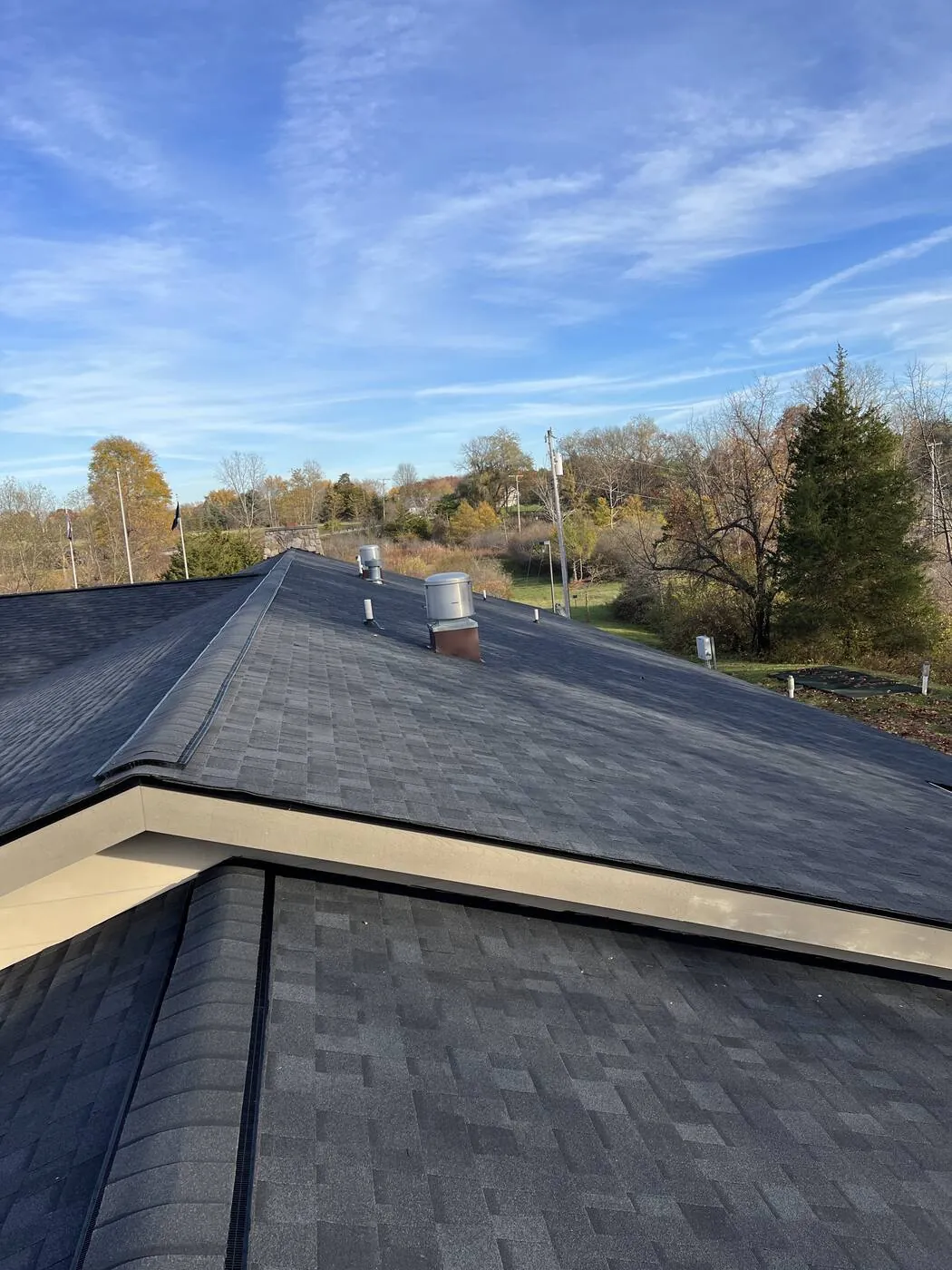
Drip edge is a bent strip of metal installed along the edges of your roof, under the shingles, that carries water off the roof and into the gutter instead of letting it curl back onto the wood behind it. On a shingle roof in Michigan it is not optional: the Michigan Residential Code requires drip edge at both the eaves and the rakes. If your roof was put on without it, the fascia and the bottom edge of the roof deck are usually where you will see the damage first.
What drip edge actually does
Water does not fall cleanly off the edge of a shingle. It clings to the underside and runs backward, a habit roofers call capillary action. Without a metal edge to break that path, rain and snowmelt wick back onto the edge of the roof deck, into the top of the fascia board and behind the gutter. Over a few seasons that turns into soft, dark wood at the roof edge, peeling paint on the fascia and gutters that start pulling away from the house.
Drip edge also does a few quieter jobs. It stiffens the edge of the roof so the first course of shingles has a straight, solid line to sit on. It closes the small gap between the deck and the fascia where wasps, squirrels and wind-driven rain like to get in. And on the rakes, the sloped sides of a gable, it gives the wind less of a lip to grab when a strong gust comes across the roof.
What the Michigan Residential Code requires
Section R905.2.8.5 of the Michigan Residential Code covers drip edge on asphalt shingle roofs, and it is specific. Here is what it calls for:
- Drip edge at the eaves and at the rake edges of every shingle roof.
- Adjacent pieces overlapped by at least 2 inches, so there are no open seams.
- The metal extending at least 1/4 inch below the roof sheathing, so water drops clear of the wood.
- The flange running at least 2 inches back onto the roof deck.
- Fasteners into the deck no more than 12 inches apart.
- Underlayment installed over the drip edge at the eaves and under the drip edge at the rakes.
That last detail matters more than it sounds. At the eave, water running down the underlayment needs to land on top of the metal and drain off. At the rake, the metal needs to lap over the underlayment so wind-blown rain cannot get behind it. When we tear off an older roof in Howell or Brighton and find rotted decking along the edges, the cause is very often drip edge that was missing, too short, or lapped the wrong way.
Drip edge vs. gutter apron
You will hear both terms, and they are related but not identical. Gutter apron is a profile of drip edge shaped with a longer, angled face that reaches down into the gutter. It is a good choice at eaves where the gutter sits a little low or where there is a gap between the roof edge and the back of the gutter. Standard drip edge profiles, often called D-style or T-style, have a shorter face and are typically used on rakes and on eaves where the gutter is tight to the fascia. The right profile depends on how your gutters hang, and on a full replacement we choose it edge by edge.
How to tell if your roof has drip edge
You can usually check from the ground or a short ladder. Look at the very edge of the roof along the gutter line and along the sloped sides of a gable. If you see a thin strip of metal, often white, brown or black, between the first shingle and the fascia board, you have drip edge. If the shingles simply hang over bare wood, you do not.
Signs that drip edge is missing or failing include peeling or rotting fascia, stains running down the face of the gutter, wood at the roof edge that looks dark or crumbly, gutters pulling away from the house, and wasp nests tucked up along the roof line. In winter, icicles that form behind the gutter rather than off its front lip are another clue that water is finding its way behind the edge.
Can drip edge be added without a new roof?
On the rakes, sometimes. On the eaves, it is difficult to do well. Drip edge belongs under the shingles and, at the eave, under the underlayment and ice barrier, which means retrofitting it properly involves lifting the first courses of shingles that have already sealed down. On a roof with plenty of life left, a careful roof repair along a damaged edge can make sense. On a roof that is near the end of its life, the practical answer is to install drip edge correctly as part of the replacement.
How we install it
Every roof replacement we do includes new drip edge on every eave and rake, color matched to the trim, lapped and fastened the way the code and the manufacturer call for. It goes in as part of a complete Owens Corning roofing system, together with ice and water barrier past the code minimum at the eaves, synthetic underlayment and balanced ventilation. As an Owens Corning Platinum Preferred Contractor, a designation held by about one percent of roofing contractors, we register that complete system warranty in your name.
Drip edge questions we hear often
Is drip edge required in Michigan?
Yes. The Michigan Residential Code requires drip edge at the eaves and rake edges of asphalt shingle roofs.
Does drip edge go over or under the gutter?
Drip edge is installed on the roof, under the shingles, and its face hangs into or just behind the back of the gutter so water drops into the gutter. It does not sit under the gutter hangers.
Should drip edge match my gutters or my roof?
Most homeowners match it to the trim or the gutters so the roof edge reads as one clean line. We bring color samples to the inspection so you can see the options against your house.
Can a roof pass inspection without drip edge?
On a new shingle roof where a permit is pulled, missing drip edge is a code issue. On an older roof installed before the requirement, it is simply a weak point worth correcting at replacement.
Get your roof edges checked
If your fascia is peeling or your gutters are pulling loose, we will tell you whether the edge of the roof is the reason. On Top Roofing has been family-owned in Howell since 2010, and our inspections across Livingston County and Greater Southeast Michigan are free, with written findings and photos. Call (810) 588-3933 or request your free estimate on this site.