Roofing blog
Hip Roof vs. Gable Roof: How Each Handles Michigan Weather
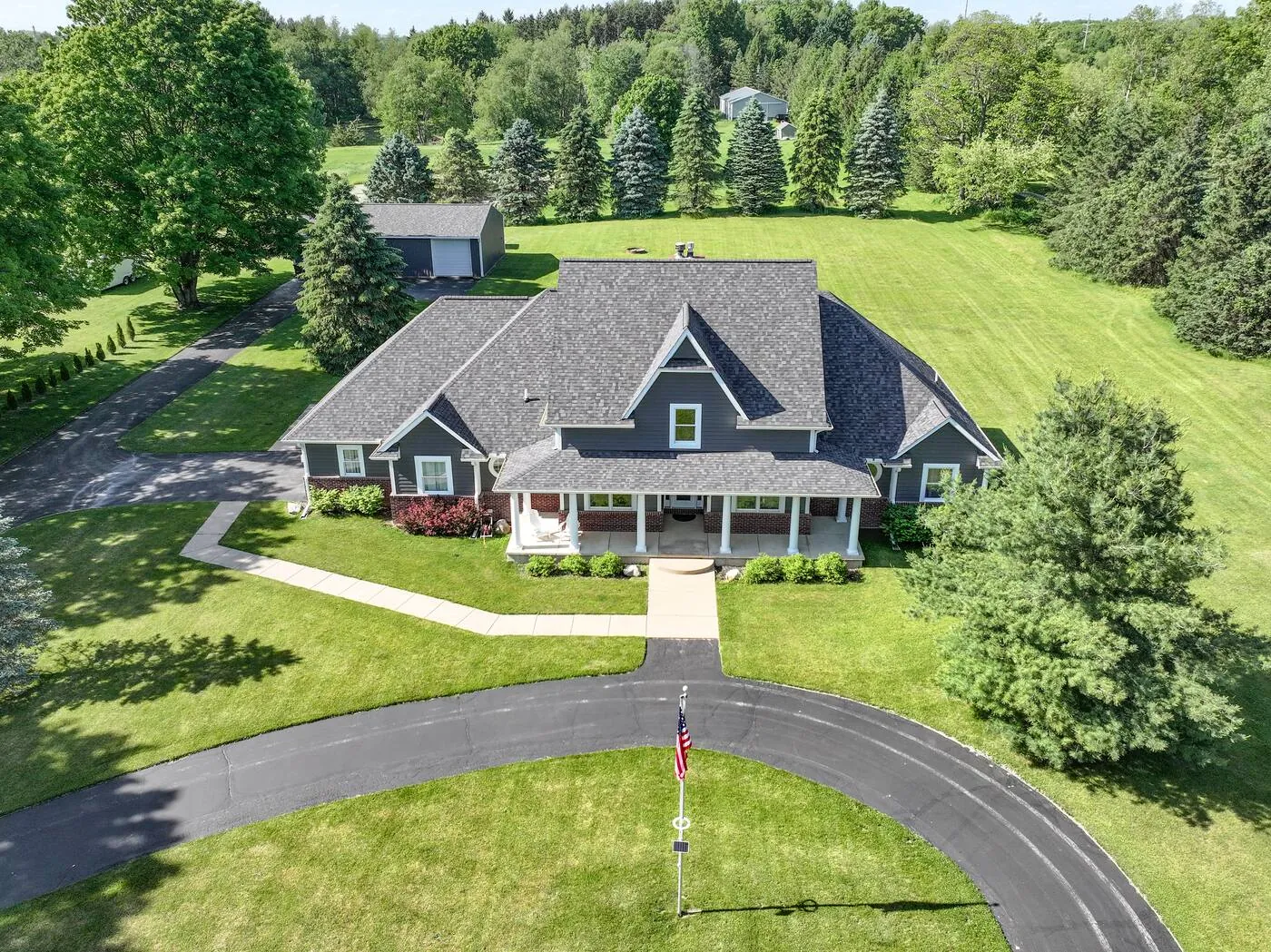
A gable roof has two sloped sides that meet at a ridge, with a triangular wall at each end. A hip roof slopes down on all four sides, with no tall flat end walls. In strong wind, research consistently shows hip roofs perform better, while gable roofs are simpler, easier to ventilate and give you more attic space. Both are excellent roofs in Michigan when they are built and roofed correctly, and on most homes the shape was decided when the house was built.
How to tell which roof you have
Stand at the end of your house and look up. If you see a tall triangle of siding or brick rising to the peak, that end is a gable. If the roof slopes down toward you at the end as well, that end is a hip. Plenty of Livingston County homes are a mix: a hip roof on the main house with gables over the garage or a front entry, or a gable roof with a small hip over a porch. That mix matters, because each section behaves according to its own shape.
Wind: where hip roofs have the edge
Wind is the weather event that damages the most roofs in our area. Summer storms produced an estimated 70 mph gust in Howell as recently as September 2026, and roofs on open lots and lakefronts take the brunt of storms like that. This is where roof shape makes a real difference.
A hip roof is braced on every side by its own geometry, and it presents a low slope to the wind from any direction. Wind tunnel research cited by the U.S. Department of Energy's Building America program found peak wind pressures on a hip roof can be as much as 50 percent lower than on a comparable gable roof. A gable roof has two weak points: the tall end walls, which the wind pushes against like a sail, and the rake edges along the sloped sides, where wind can get under the first row of shingles. FEMA's post-storm damage studies point to poorly braced gable end walls as a common failure point, and shingle loss on any roof tends to start at the edges.
None of that means a gable roof is a bad roof. It means the rakes deserve extra attention: proper drip edge, a starter strip run up the rakes, the full manufacturer nailing pattern and shingles with a reinforced nailing zone. Those details are what separate a gable roof that loses shingles in every storm from one that does not.
Snow and ice
Both shapes handle Michigan snow well when the pitch is reasonable and the attic is ventilated. The difference is in where the trouble spots are. A hip roof has more eave length, since it has an eave on all four sides, which means more edge where ice dams can form if the attic is losing heat. It also has hip lines and often more valleys where it meets wings and garages. A gable roof has fewer eaves and fewer valleys, so it tends to have fewer places for ice and water to collect.
On either shape, the defense is the same: ice and water barrier from the eaves well past the code minimum of 24 inches inside the exterior wall, membrane in every valley, and an attic that stays cold. Our article on ice dams on Michigan roofs covers the fixes that last.
Ventilation and attic space
This is where gable roofs win. A gable roof has a long, continuous ridge that is ideal for a ridge vent, plus a roomy attic with plenty of space for air to move. A hip roof has a shorter ridge, sometimes very short on a square house, and the attic tapers on every side. That does not make a hip roof hard to ventilate, but it does mean the exhaust has to be planned instead of assumed. Depending on the house, that can mean hip vents, a carefully sized ridge vent or other exhaust, always balanced with open soffit intake.
Hip roof vs. gable roof at a glance
- Wind: hip roofs generally perform better; gable roofs need well-detailed rakes and braced end walls.
- Snow and ice: both perform well; hip roofs have more eave length to protect.
- Ventilation: gable roofs ventilate easily along a long ridge; hip roofs need more planning.
- Attic space: gable roofs give you more usable attic.
- Complexity: hip roofs have more hips, ridges and often valleys to detail correctly.
- Look: hip roofs read as low and even; gable roofs read as traditional and vertical.
What this means when you replace your roof
Changing a roof's shape means reframing it, which is a major remodeling project rather than a re-roof, so for most homeowners the shape is fixed. What you control is how well the roof is detailed for its shape. On a gable roof, that is the rakes and the end walls. On a hip roof, it is the hips, the valleys, the extra eave length and the ventilation plan. On a mixed roof, it is every transition between the two.
On every roof replacement, we install Owens Corning shingles with a reinforced nailing zone, matching hip and ridge caps, drip edge on every eave and rake, ice and water barrier past the code minimum and ventilation sized to your attic. As an Owens Corning Platinum Preferred Contractor, we register that complete system in your name. If you are planning an addition or a new garage, we also help with matching the new roof lines to the existing house, which we cover in our post on new construction and addition roofing.
Hip and gable roof questions
Is a hip roof better in Michigan?
For wind resistance, generally yes. For simplicity, attic space and ventilation, a gable roof has the advantage. Either is a long-lasting roof when it is installed correctly.
Do hip roofs leak more?
Not when they are detailed correctly, but they do have more hips and valleys, which are places where a poor installation shows up first.
What is a Dutch gable or a gambrel?
A Dutch gable puts a small gable on top of a hip roof. A gambrel has two slopes on each side, steeper at the bottom, like a barn. Both are common variations, and each has its own details to get right.
Does roof shape affect how long shingles last?
Indirectly. Exposure, pitch and ventilation affect shingle life more than shape does, but a hard-to-ventilate attic can shorten shingle life on any shape.
See what your roof shape needs
We will walk your roof, show you the weak points for its shape and put our recommendations in writing with photos. The inspection is free for homeowners in Howell, Brighton, Hartland and across Greater Southeast Michigan, and our inspectors are HAAG Certified. Call On Top Roofing at (810) 588-3933 or request your free estimate.