
Roofing blog
What Is a Chimney Cricket, and Does Your Roof Need One?
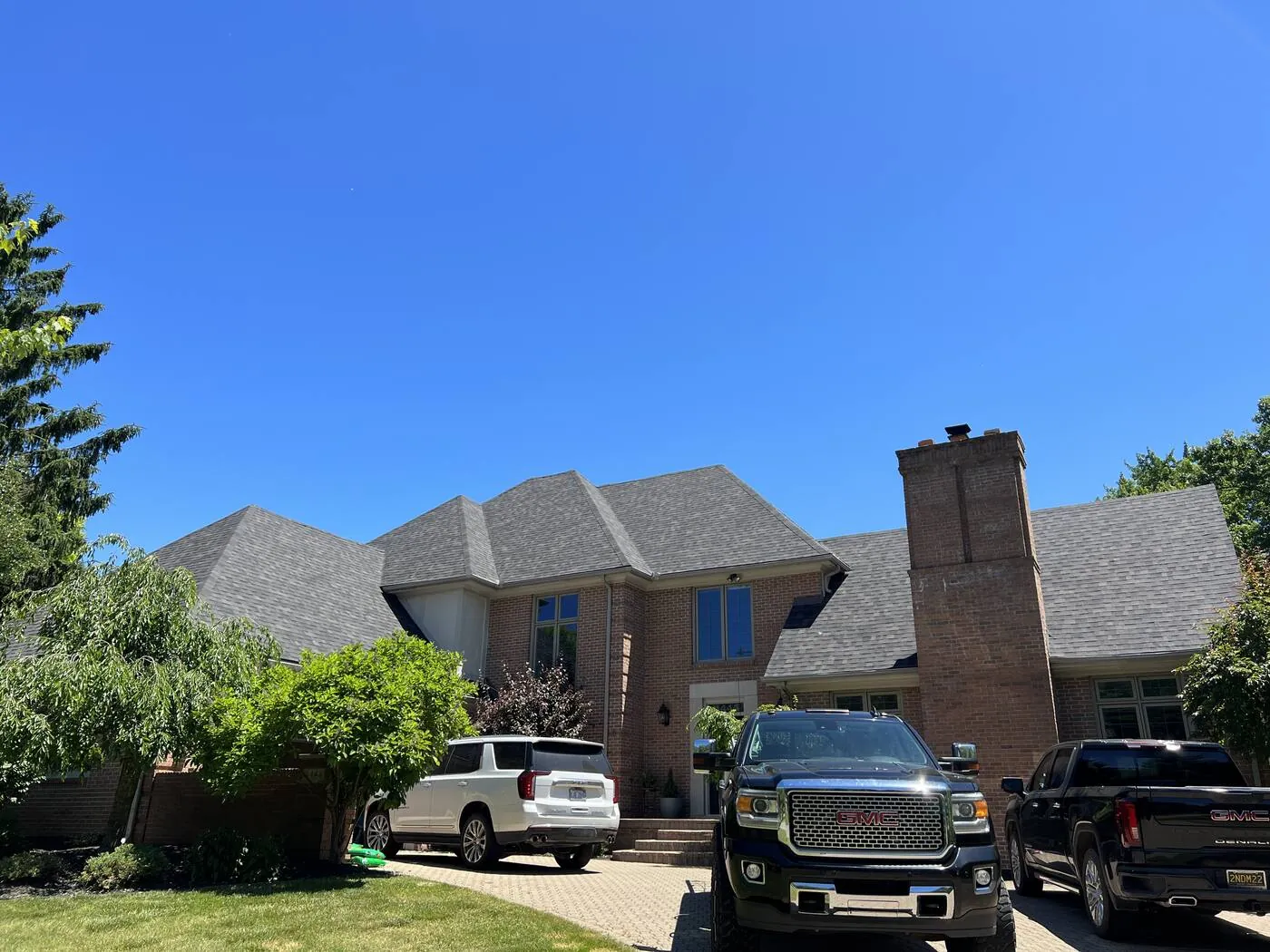
A chimney cricket, also called a saddle, is a small peaked roof built on the uphill side of a chimney so that water, snow and debris split and flow around the chimney instead of piling up against it. The Michigan Residential Code requires a cricket on chimneys wider than 30 inches, measured parallel to the ridge, unless the chimney sits at the ridge. On a wide chimney in a Michigan winter, a missing cricket is one of the most reliable ways to get a leak.
Why the uphill side of a chimney is a problem
Picture rain running down a roof slope and meeting a brick wall. On a narrow chimney, the water parts and runs around it easily. On a wide chimney, it slows, pools and soaks into the joint where the shingles meet the brick. Leaves and pine needles collect in the same spot and hold that water against the flashing for days.
Winter makes it worse. Snow drifts against the back of the chimney and sits there long after the rest of the roof has cleared. Every sunny afternoon melts a little of it, and every cold night refreezes it, which is the same freeze-thaw cycle behind ice dams at the eaves. Water that is backed up against the chimney gets pushed under the shingles and behind the flashing. The result is a stain on the ceiling near the fireplace, damp drywall beside the chimney chase, or rot in the roof deck that nobody sees until the shingles come off.
What a cricket does
A cricket turns that flat wall into a ridge. It is framed like a miniature roof, sheathed, covered with ice and water barrier and roofing, and flashed into the chimney. Water and snow that would have stopped at the chimney instead hit the peak of the cricket and slide off to either side, where step flashing carries it down past the chimney. Debris has nowhere to collect. It is a simple piece of carpentry that removes the single worst spot on many roofs.
When Michigan code requires a chimney cricket
Section R1003.20 of the Michigan Residential Code requires a cricket where the chimney dimension parallel to the ridgeline is greater than 30 inches and the chimney does not intersect the ridgeline. The code includes a table that sets the cricket's height based on the chimney width and the roof pitch, and it requires the cricket to be flashed and counterflashed the same way as any roof-to-chimney intersection.
In practice, a cricket is worth considering in these situations:
- Any chimney more than 30 inches wide that sits partway down the slope
- A chimney with a history of leaks on the uphill side, even if it is narrower
- Roofs under tall trees, where needles and leaves collect behind the chimney
- Low-pitch roofs, where water moves slowly and pools more easily
- A chimney chase or wide framed chase on a newer home, which acts like a wall on the roof
- Skylights or other penetrations placed close behind a chimney
Signs your chimney needs a cricket or new flashing
Inside, look for water stains on the ceiling or walls next to the fireplace or chimney chase, especially ones that get worse after heavy snow or a thaw. In the attic, look for darkened wood or wet insulation where the chimney passes through. Outside, from the ground, look for roof cement smeared along the back of the chimney, which is a sign it has leaked before, and for moss or debris piled up behind it.
Not every chimney leak is a cricket problem. Cracked mortar, a failed crown or an open cap can all let water into the masonry itself. Old flashing that was surface-caulked instead of stepped into the shingles and counterflashed into the mortar joints is another common cause. We wrote more about this in our post on where roofs fail first. A good inspection separates those causes so the fix matches the actual problem.
Can a cricket be added to an existing roof?
Yes. A cricket can be framed in on its own as part of a chimney flashing roof repair: the shingles behind the chimney are removed, the cricket is framed and sheathed, ice and water barrier goes down, and the area is reflashed and reshingled to blend into the surrounding roof. On an older roof, matching the existing shingles exactly can be difficult, which is one more reason the best time to add a cricket is during a full replacement.
How we handle chimneys on a roof replacement
On every roof replacement, each chimney gets new step flashing woven into the shingle courses, new counterflashing cut into the mortar joints on brick chimneys, ice and water barrier around the base, and a properly sized cricket behind any chimney wide enough to need one. We do not reuse chimney flashing or rely on caulk. That detail work is part of the complete Owens Corning roofing system we install and register in your name as an Owens Corning Platinum Preferred Contractor.
Chimney cricket questions
What is the difference between a cricket and a saddle?
Nothing. Both terms describe the same small peaked structure behind a chimney. Some roofers also call it a diverter.
Does a narrow chimney need a cricket?
Code does not require one on chimneys 30 inches wide or less, and good step flashing and counterflashing usually handle them well. A cricket can still help on a narrow chimney with a history of leaks or heavy debris.
What is a cricket made of?
Most are framed with lumber, sheathed with plywood or OSB, covered with ice and water barrier and finished with shingles or metal to match the roof, then flashed to the chimney.
Will a cricket stop ice dams?
It prevents snow and water from damming behind the chimney. Ice dams at the eaves have a different cause, which is heat loss and ventilation, and need their own fix.
Have your chimney looked at before winter
If you have a wide chimney, a stain near the fireplace or a patch of roof cement behind the brick, now is a good time to have it checked. Our inspections are free and include photos of the back of the chimney you cannot see from the ground. On Top Roofing serves Howell, Brighton, Hartland and Greater Southeast Michigan, and our inspectors are HAAG Certified. Call (810) 588-3933 for your free estimate.