
Roofing blog
Frost Damage on Michigan Roofs: Causes, Signs and Fixes
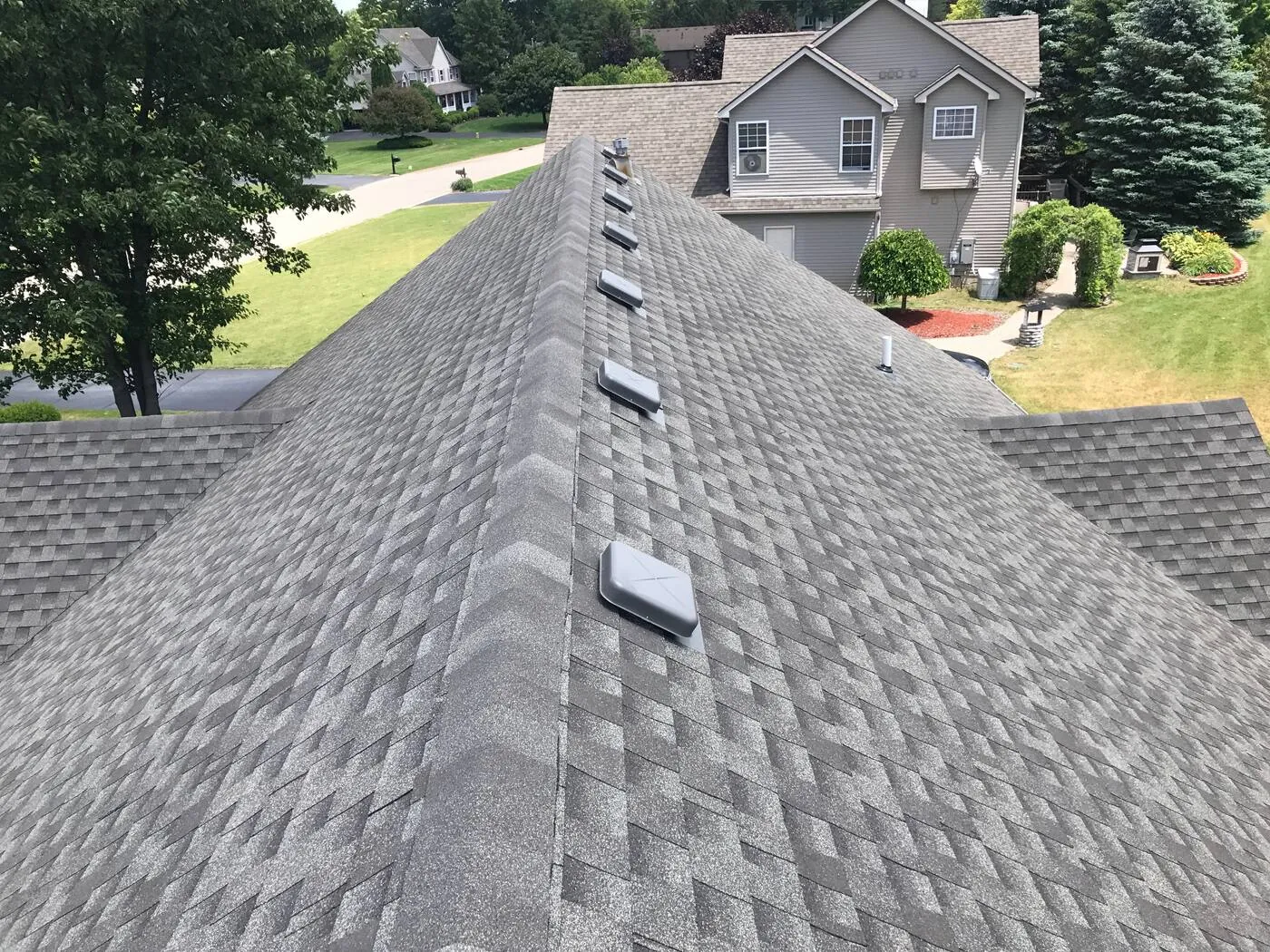
Frost on the outside of your shingles on a cold Michigan morning is normal and does no harm. The frost that causes damage is the kind you do not see: water that freezes inside cracks and seams on the roof surface, and frost that builds up on the underside of the roof deck in your attic. In Howell and across Livingston County, the roof crosses the freezing line again and again through the winter, and each cycle gives that hidden moisture another chance to work on the shingles, the flashing and the wood underneath.
This guide explains where frost damage really comes from, how to spot it early and what actually fixes it, so a winter problem does not turn into a spring leak.
Frost on the shingles vs. frost in the attic
It helps to separate two very different things that both get called frost damage.
- Surface frost and freeze-thaw. Dew settles on the roof overnight and freezes. On its own that is harmless. The trouble starts where water has already found a way in, such as a cracked shingle, a lifted tab, a dried-out pipe boot or a gap in old flashing. That water freezes, expands, and opens the gap a little wider every cycle.
- Attic frost. Warm, moist air from the living space leaks into a cold attic, touches the underside of the roof deck and freezes into a layer of frost on the wood and the nail tips. When the weather warms up, it all melts at once and drips onto the insulation and ceiling. Many homeowners mistake this for a roof leak.
Both get worse on Michigan homes for the same reason: our winters do not stay frozen. A roof in Greater Southeast Michigan can go from well below freezing overnight to a sunny thaw in the afternoon, then back again, dozens of times between November and March.
How freeze-thaw wears down a roof
Water expands by about 9 percent when it freezes. A small amount trapped in a crack does not sound like much, but repeated all winter it pries shingles, sealant and flashing apart a little at a time. On a roof in good condition, the shingles shed water before it can collect, and freeze-thaw does very little. On an older roof, it speeds up the decline.
These are the places freeze-thaw damage shows up first on homes we inspect in Howell, Brighton, Hartland and Fowlerville:
- Shingles that are already cracked, curled or lifting. Water gets under the edge, freezes and lifts it further. We explain what each kind of shingle wear means in our guide to curling, cracked and lifting shingles.
- Nail pops. A nail that has backed out lets water run down the shank and freeze around it, pushing the nail and the shingle above it up further. See what causes nail pops.
- Flashing that relies on caulk. Sealant along a chimney or wall line cracks in the cold, and water follows the crack. Our article on roof flashing covers why lapped metal holds up where caulk does not.
- Pipe boots. The rubber collar around a plumbing vent dries out and splits, and freeze-thaw widens the split. Here is why pipe boots fail.
- The eaves. Ice dams back meltwater up under the bottom courses of shingles, where it freezes and thaws against the deck. That is why soft or rotted decking is so often found along the eaves.
What causes frost in the attic
Attic frost is a moisture problem, not a shingle problem. It needs two things: warm, damp air getting into the attic, and not enough airflow to carry that moisture back outside before it freezes. The usual causes are:
- Air leaks from the house. Gaps around recessed lights, attic hatches, plumbing and wiring holes and the tops of interior walls let warm, humid air rise straight into the attic.
- Bath and kitchen fans that vent into the attic. Every shower sends a cloud of moisture up. A fan that ends in the attic, or a duct that has come loose, deposits it right on the roof deck.
- Poor or unbalanced ventilation. An attic needs air coming in low at the soffits and leaving high near the ridge. Blocked soffit vents, missing baffles or a mix of vent types that work against each other leave moist air sitting in the attic. Our guide to roof ventilation and insulation explains how balanced airflow works.
- Thin or uneven insulation. Missing insulation lets more heat and moisture into the attic and also feeds ice dams on the roof above.
The Michigan Residential Code sets minimum attic ventilation based on the attic floor area, with the intake and exhaust split so air moves from the eaves to the ridge. Many older homes, and some newer ones, fall short because vents were covered by insulation or a remodel changed the airflow.
Signs of frost damage to look for
Most of these can be checked from the ground or with a flashlight in the attic on a cold morning:
- Frost or ice on the underside of the roof deck or on the nail tips in the attic
- Water stains on the ceiling that appear during a thaw, then dry up
- Damp, matted or stained insulation, or dark spots on the attic sheathing
- Rusty nail tips or a musty smell in the attic
- Granules collecting in the gutters or at the bottom of downspouts
- Shingle edges that are lifting, cracking or curling, especially on the north side of the roof
- Icicles and ice dams along the same stretch of eaves every winter
How frost damage is fixed
The right fix depends on which kind of frost problem you have and how much life is left in the roof.
If the problem is in the attic
Start with the moisture source, not the roof. Sealing air leaks at the attic floor, making sure every bath and kitchen fan exhausts outdoors, and opening up blocked soffit vents usually stops attic frost. Adding ridge or other exhaust ventilation where the attic is short of it finishes the job. Once the moisture is under control, the roof deck dries out and the frost stops forming.
If the damage is on the roof surface
If the roof is in good shape overall, a targeted roof repair handles the weak spots: replacing cracked or lifted shingles, resetting nail pops, replacing pipe boots and replacing caulked flashing with properly lapped metal.
If the roof is near the end of its life
When frost and freeze-thaw damage are spread across an older roof, patching rarely keeps up. A roof replacement lets us see the whole deck, replace any soft or rotted sheathing and correct the ventilation at the same time. On every replacement we install ice and water barrier past the code minimum at the eaves and up every valley, new flashing and pipe boots, and balanced intake and exhaust ventilation.
As an Owens Corning Platinum Preferred Contractor, we install complete Owens Corning systems, with matched underlayment, ice and water barrier, starter, ventilation and shingles designed to work together. That full-system approach is what lets us register the strongest Owens Corning warranty coverage in your name.
How to prevent frost damage next winter
- Have the roof and attic inspected in the fall, before the first hard freeze.
- Check that bath and kitchen fans vent outside, and run bath fans for 20 minutes after a shower.
- Keep soffit vents clear of insulation and debris.
- Seal around attic hatches, recessed lights and pipe openings.
- Keep gutters and downspouts clear so meltwater can drain.
- Use a roof rake from the ground after heavy snow, and stay off an icy roof. Our article on how much snow a roof can hold explains when clearing snow makes sense.
Frost damage questions
Is frost on my roof bad?
Frost on the outside of the shingles is normal and harmless. It becomes a problem only where water can get into cracks, lifted shingles or worn flashing and freeze there, or when frost is forming inside the attic.
Why is there frost on the underside of my roof in the attic?
Warm, moist air from the house is reaching the cold roof deck and freezing. The usual causes are air leaks from the living space, bath or kitchen fans venting into the attic, and blocked or unbalanced ventilation. Fixing the moisture source and the airflow stops it.
Can attic frost cause a leak?
Yes. When the weather warms up, the frost melts all at once and drips onto the insulation and ceiling. Many winter stains that look like roof leaks are actually melting attic frost.
Does frost damage mean I need a new roof?
Not usually. Attic frost is fixed with air sealing and ventilation, and surface damage on a sound roof is fixed with targeted repairs. Replacement makes sense when the roof is already near the end of its life and the damage is widespread.
Get your roof checked before the next freeze
If you are seeing winter stains, attic frost or granules in the gutters, we are happy to take a look. Our roof inspections are free in Howell, Brighton, Hartland, Fowlerville, Pinckney and across Greater Southeast Michigan, and we check the attic as well as the shingles and show you photos of what we find. Our inspectors are HAAG Certified. Call On Top Roofing at (810) 588-3933 or request your free estimate.